After another fantastic international ML conference with ICLR in Brazil, I’ve felt it important to jot down some thoughts about the global ML community. Note that this is primarily my experience and narrow perspective. The main point that I want to get across is that an international community of scientists is a wonderful benefit to humanity. We should be doing everything we can to resist setting up barriers to the good-faith interchange of ideas and avoid making nationalistic claims on where ideas or technologies originate.
While I was not raised in a wealthy family, relative to Western (American) norms, I had a lot of privileges growing up. My parents helped to instill in me a sense of wonder about the world, an appreciation for art and culture (not always a deep appreciation mind you), and an appetite for exploration. Having divorced our mother pretty early in my childhood my father flew my brother and I to visit him wherever he was living or wanted to vacation. We accumulated our fair share of frequent flier miles before turning 18 and were able to be thrust well out of our comfort zones in places we did not speak the language. After spending two years as a missionary in Sweden, I envisioned that travel would continue to be a large part of my life. In fact, a small part of what attracted me to the life of an ML researcher was that conferences had a history of being organized all over the world.
However, after marrying and having children young (the best decisions of my life) plus the onset of a global pandemic during my PhD, this life of travel never really materialized. Despite missing out on being immersed in new places and cultures, I never lacked opportunities to enrich my worldview. I have been fortunate to work with and learn alongside other people from all over the world. Through these interactions as well as an ever growing (and ever disappointing) discourse about immigration and any research or technological advancement’s nation of origin, I feel the need to articulate that we as a ML community are stronger when working together. The global diffusion of talent and capital investment in ML should be viewed as a positive sign of growth. When institutions ascribe geopolitical barriers to science, the resulting distrust of those not of one’s “tribe” serves to limit the dissemination and integration of the best ideas. Progress stagnates, truly impactful work becomes harder to distinguish.
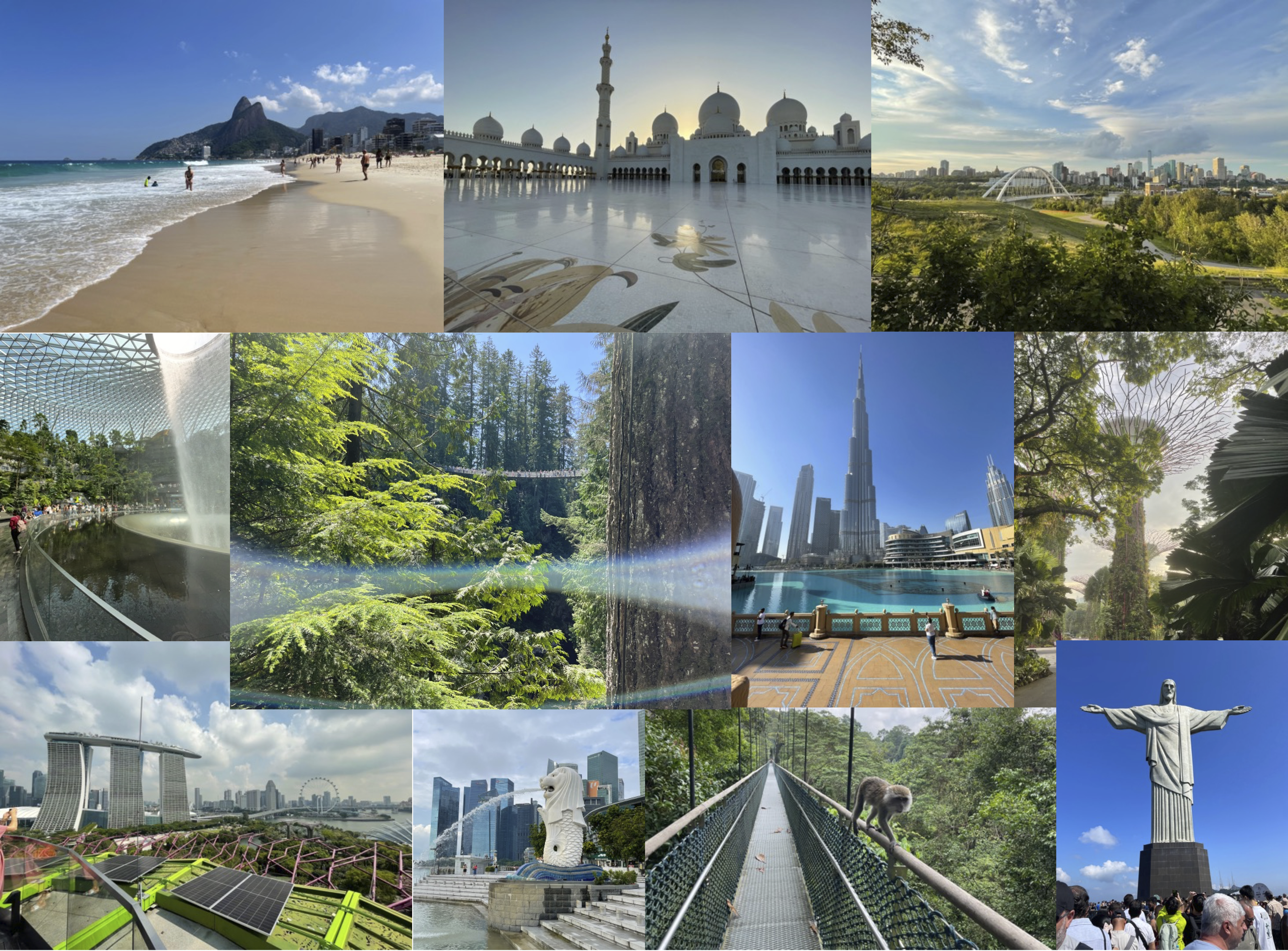
Over the past year I’ve been incredibly fortunate to have been afforded the opportunity, through my employer, to realize my world traveling dreams. I am lucky to have had the privilege in 2025 (and so far in 2026) to attend all major ML conferences, RLC included!, as well as a summit in Abu Dhabi with MBZUAI. This has allowed me to visit new areas of the world that I probably wouldn’t have ever chosen to travel on my own. I’ve learned more about myself while developing a deeper respect for a broader swath of people, where they come from, and how they approach science. While I’m very tired of long plane rides and time away from my family, I’m really grateful for the perspective I’ve gained visiting Asia (Singapore counts right, just a little bit?), South America, the Middle East, and even places I’ve been before in North America. I’ll have more to share about my experiences in Abu Dhabi and with MBZUAI in a future post and how it has helped shape my current and future career trajectory. In aggregate over all of my travel in the past 12 months two lessons have been reinforced:
- There is beauty everywhere. The world is an amazing place. We should protect it as much as we can.
- People are right to be proud of where they come from. They are usually craving opportunities to share what they love about their home.
On a personal level I hope to be a better father, spouse, friend, and neighbor as a result of this travel. I know that I am a better scientist from interacting face-to-face with people discussing our work.
Science is a global endeavor. I believe that it was Tom Dietterich who once said that science is best viewed as a relay race. It may be helpful to imagine a broader interpretation of this “race” as a wilderness adventure where the route is not explicitly set and the end goal is not explicitly determined. Part of the beauty of science truly is exploration and knowledge creation. You sometimes have an objective result in mind, other times you’re simply curious whether you can bring tangential concepts together to make something new. You take the baton from prior work, push ideas as far as you can and then stand ready to pass the baton to others via open dissemination of what you learn. Sometimes you go further than you had before. Sometimes you take the race in a new direction. Sometimes you start a new race. You get farther the less worried you are about who came before or after you. You move faster and more happily when you find a set of people enthusiastically engaged in taking the baton from the same origin point. Sure, there’s always the existential fear that someone else will make your efforts obsolete. Overcoming this fear and removing these risks is part of the development of one’s research taste (a topic for future writing I think) and maturation as a scientist. All this is to say that I feel that the value we should be genuinely excited about is the quality of ideas, the rigor with which they are established, and pay less attention about where they’re coming from.
Granted, there are obvious reasons whereby nation-states or broader national organizations will choose to hold back access to breakthroughs or technological developments for security or defense reasons. There are appropriate concerns about how technology is deployed, how policies are enacted (or baked in) that may harm or disadvantage others. Companies will naturally be incentivized to protect proprietary information. I’ve participated in this approach to science, it has its time and place. However, it has been my experience that the process of science, where it is refined, where it’s positive impacts are magnified is best borne through global collaborative interchanges. This can take many forms; academic communities publishing their work with full scholarly integrity, open source development, widely disseminated educational opportunities, and so on. If AI is to ever reach its fullest potential, we should hope that the greatest number of people are working to advance the frontier as possible. As much as we can get diverse groups working together all the better. Even something as narrowly scoped as “competition” helps breed innovation. Again, the forcing function of progress here is again the value of one’s ideas. Let’s work together to promote good-faith debates and discussions about what we’re curious about. Let’s find and promote spaces where this interchange can be most easily accessed. Let’s be sure to do so without resorting to inane “us” vs. “them” dialogues.
(I know I know, access to resources such as compute, e.g. $$$ make a big difference. There are even inequities in one's access to mentorship. But even with the most compute and near limitless capital, a lack of concrete ideas or an inability to freely explore new approaches can severely limit what an institution can accomplish.)